
Active
Operation depends on pump, power supply and free pipeline routes.
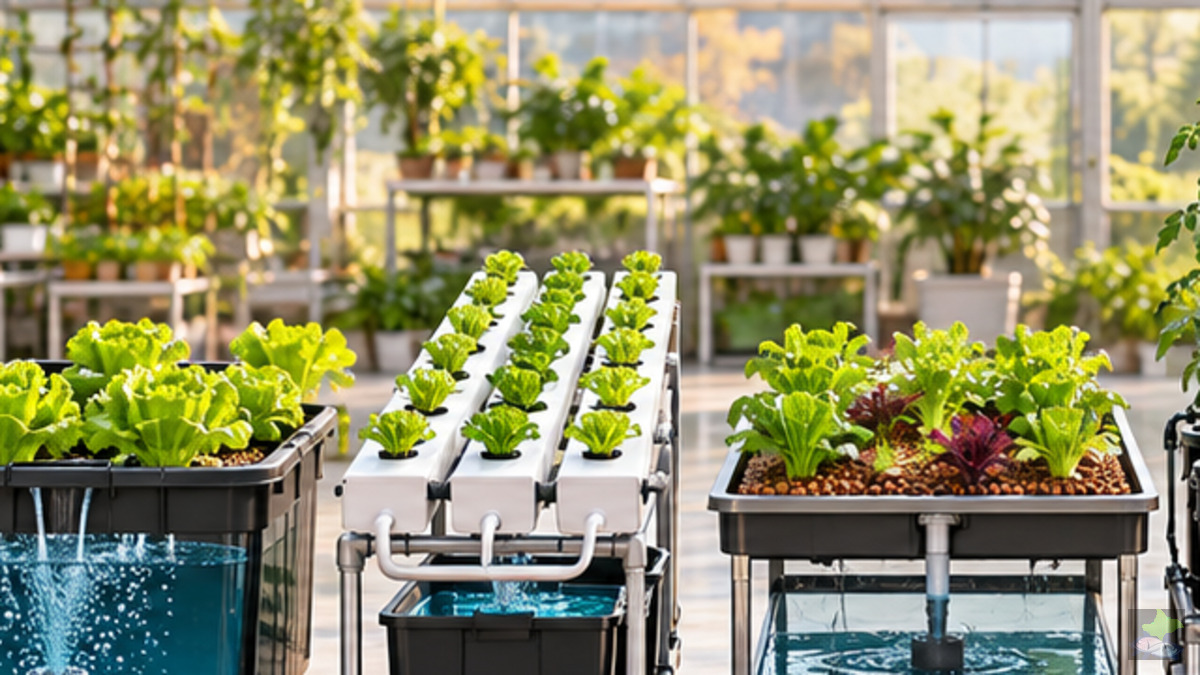
Hydroponics systems · Recirculating culture management
Roots in a continuously guided nutrient film – hydraulically planned, measurably operated and protected against flow failures.
Orientation
Definition and demarcation
Nutrient Film Technique here designates an active, recirculating hydroponic system. A pump conveys nutrient solution from a reservoir into slightly inclined culture channels. There, a flat, continuous film wets part of the root surface; the solution subsequently flows back to the reservoir.
A partially filled pipe is not automatically NFT. Functionally crucial are a defined free drain, an evenly distributed thin film, sufficient air space in the channel and a safe return.
Operation depends on pump, power supply and free pipeline routes.
Water and dissolved nutrients are returned, controlled and corrected.
The roots are wetted without permanently flooding the entire channel cross section.
NFT is not a collective term for any pipe hydroponics. Characteristic is a very flat, recirculating solution film on the channel bottom, while a large part of the root surface in the moist channel space remains in contact with air.
The delimitation affects the entire construction: canal floor, run-in, drain and gradient must allow for a free film. If the cross section is permanently flooded deep, oxygen path, storage effect and failure reaction change.
In operation, therefore, it is not only checked whether water arrives at the canal end. Decisive are film distribution, free surface, backlog, root contact and the condition of all individual channels.
G01 · System circuit
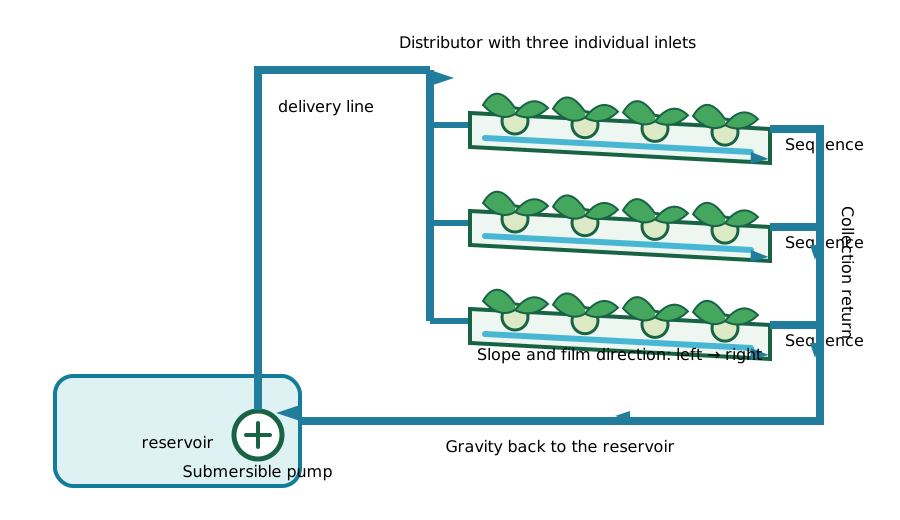
Circulation
The pump generates the delivery flow; gravity takes over the path through the inclined channels and the return. Plants extract water and nutrient ions, while evaporation, temperature, gas exchange and microbial processes continuously alter the solution.
The repatriation makes NFT water-efficient, but not loss-free. Complementary water, nutrient corrections, cleaning and, where appropriate, solution changes remain part of the operation.
The pump delivers pressure energy up to the highest feed point. From there, gravity moves the solution through the inclined channel and the collection return. Water, dissolved ions, heat and oxygen change during each passage.
The delivery and return sides are accounted for separately. The feed line must overcome height and friction losses; the return line needs a gradient, sufficient cross section and reserve for the simultaneous drainage of all channels.
Plants do not extract water and nutrients in the same proportion. Supplemental water, nutrient corrections and discharges therefore change the solution even if the circulation volume remains externally constant.
Plant technology
Provides working volume and buffer for temperature, concentration and level.
overcomes height differences and provides the required total current.
divides the delivery flow into individual channels in a controllable manner.
brings together film, roots and plant position without stowage.
returns the solution freely, in a controllable manner and, if possible, without overload.
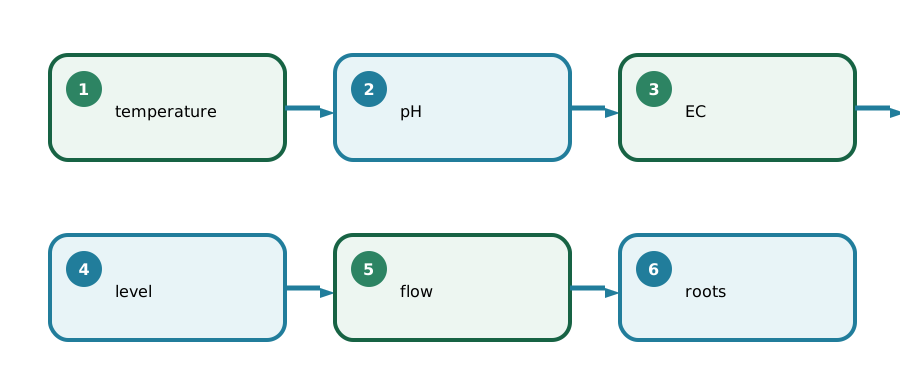
makes level, temperature, pH, EC and flow visible as a curve.
Functional reliability arises from the interaction of all components. A sufficiently large reservoir can buffer fluctuations; However, it does not replace measurement routine or correctly dimensioned lines.
The pump is selected on the basis of its characteristic curve at the actual delivery head. Distributors and valves shall be accessible. Channels require load-bearing contact points, reproducible gradients and dismantled cleaning paths.
Critical components are arranged in such a way that levels, filters, pump inlet, inlets and returns can be tested without dismantling the culture. Maintenance access is a design feature, not a later addition.
Root zone
The film is intended to reliably wet the underside of the root zone while maintaining a coherent air space above it. A low water level changes material transport, oxygen path and failure behavior – and can hydraulically turn an NFT channel into a different system.
Does the solution flow freely over the entire width of the canal, or do dry tracks, puddles and backwaters arise? The visible film is more meaningful than a nominal pump value.
Water is not automatically distributed evenly in the channel. Unevenness, surface tension, root strands and deposits can force the film into preferred tracks and leave other areas dry.
Flat channel floors or profiles designed for this purpose facilitate distribution. Round tubes concentrate the solution more strongly in the middle and offer less controllable free cross section as the root mass grows.
The film is controlled in several places and especially under full stock. Puddles, dry edge regions or changing flow paths are hydraulic hints and are not solved by higher pumping alone.
G02 · Root zone

Hydraulic fluid
Slope, inflow rate, roughness, channel geometry, root mass and length work together. Therefore, a single flow or gradient value is not a general interpretation. technical sources provide starting points; the specific plant needs hydraulic testing under take-off and full stock.
Incomplete wetting and rapid risk of dry stress.
Uniform film, free flow and controlled return.
Overcongestion, unequal distribution and reduced airspace.
Slope and flow interact with channel width, length and root resistance. More delivery cannot reliably compensate for a poorly aligned channel and possibly increases the build-up.
Sources give different starting values depending on the channel type, culture and test setup. These values are used for initial start-up. The release takes place only after measurement of all individual inlets and a load test of the return.
The gradient is measured along the load-bearing structure, not only at the first and last point. Bending, settling and unequally loaded overlays can produce local opposing pitches.
Geometry
A canal must accommodate not only the young plant, but also the later root mass. Inner edges, connectors and run-off points shall not form trapping points. Removable lids and accessible ends facilitate inspection and cleaning.
The usable channel cross section decreases with the root development. Roots act as biologically growing resistance to flow and can displace water laterally, upwards or into individual paths.
Cross section, planting distance and culture duration are chosen together. For longer cultures, the canal needs more root zone, more stable runs and particularly safe drainage areas.
Roots are not routinely pruned aggressively. First, planting density, canal selection and crop time are checked. Interventions on living roots increase risks of injury and hygiene.
G03 Distribution
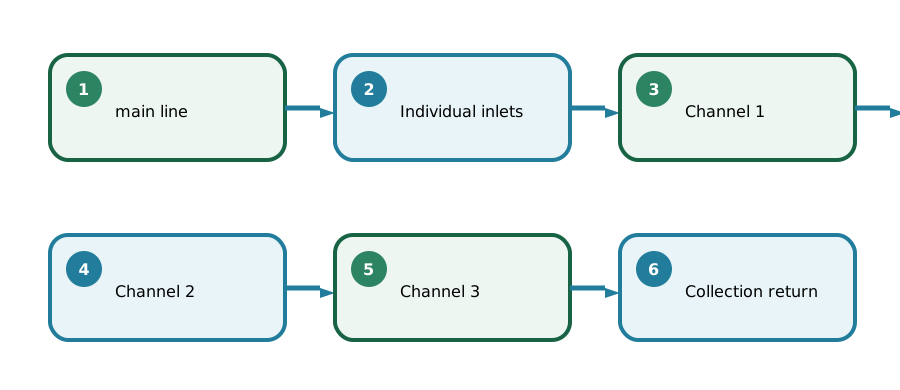
Establishment
When inserted, young roots must reach the film or a secure capillary connection. Plants that are too high and weakly rooted can dry up, although the canal is technically flowed through. Growing medium, plant height and start flow are tested together.
Young plants initially have little root mass and hardly any hydraulic reserve. The transition succeeds only if active root tips reach the film or a safe moisture pathway.
Cubes, netting pots and planting openings are combined in such a way that the cube is not permanently soaked and at the same time no dry distance from the film is created. The transfer height must be reproducible.
In the first few days, wilting, root contact and canal temperature are more frequently controlled. Individual weak plants are not compensated by permanent flooding of the entire system.
Dynamics
With growing culture, water intake and root volume increase. At the same time, hydraulic resistance can increase. An attitude that works at the beginning of culture is therefore not a guarantee of full existence.
The water demand increases with leaf area, irradiation and temperature. At the same time, the growing root mat changes flow and drainage. NFT is therefore not hydraulically static during culture.
The design shall consider at least the young plant phase, closed stand and harvest status. Return reserve and channel height are planned for the most critical phase, not the empty channel.
Trend data from inflow, return and level help to detect creeping changes. An increasing level difference or delayed execution can indicate increasing resistance.
G04 · Culture progression
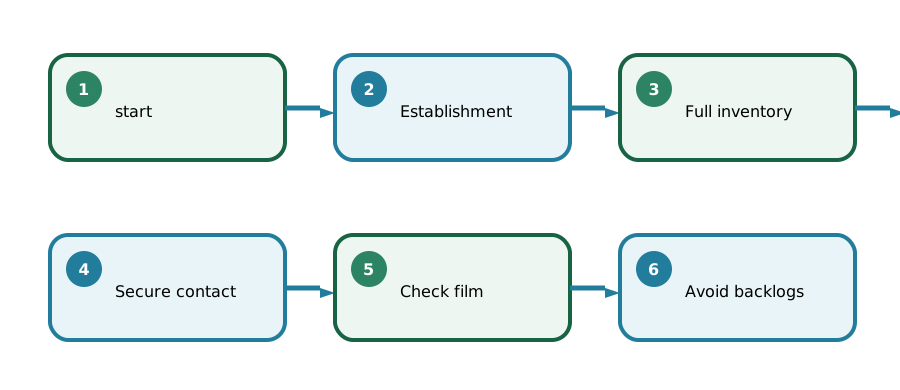
Nutrient solution
pH and electrical conductivity are course measurements, not complete nutrient analysis. Plant deprivation, evaporation and supplemental water can shift the ionic ratios. Corrections are made slowly, documented and based on culture-specific specialist information.
EC describes the total conductivity of dissolved ions. A plausible EC value proves neither a balanced recipe nor the absence of individual defects.
pH affects the chemical availability of nutrients; EC shows the total conductivity of the dissolved ions. Neither of the two values reveals the complete composition or the ratio of individual nutrients.
Starting water is examined for pH, EC and alkalinity, because bicarbonates influence the pH management and existing salts influence the later balance. Recipes are adapted to culture, development phase and water analysis.
Measuring devices are calibrated, samples are taken at defined locations and corrections are mixed in stepwise. After each addition, sufficient circulation and re-measurement is carried out; Concentrated acids or fertilizers never directly reach roots.
System climate
The dissolution temperature affects oxygen solubility, plant metabolism and biological activity. NFT combines the thin film with great air contact, but remains dependent on uniform flow and healthy roots. High temperature, organic load and standing zones increase the risk.
With increasing water temperature, the solubility of oxygen basically decreases, while plant and microorganism metabolism can increase. As a result, heat and organic load increase each other.
Reservoir, pipes and ducts are protected against unnecessary irradiation. Heat sources of the pump, room climate, lighting and returning solution are included in the temperature consideration.
Temperature is assessed along with root color, smell, flow and plant response. Additional ventilation can increase the reserve but does not fix a blocked channel or overheated location.
G05 · Monitoring
Culture choice
NFT is often used for leafy vegetables and herbs. Culture time, root volume, support needs, thermal sensitivity and planting distance determine whether the system fits. Large long-term crops and fruit crops can make greater use of canals, returns and support structures.
Short leaf cultures and many herbs often go well with NFT because root volume, culture time and support needs remain limited. However, the suitability of a species does not automatically mean the suitability of each variety.
Planting distance is derived from final size, light distribution, air movement and root zone. Too dense stocks not only reduce light and air exchange, but also increase hydraulic resistance.
Stocks are checked for uniformity along the canal. Systematic differences between beginning and end can indicate distribution, temperature, nutrient deprivation or light gradients.
Planning
A load-bearing dimensioning balances plant number, channel number, total flow rate, head, working volume, return reserve, temperature, maintenance access and expected root mass. Manufacturer characteristic curves are read under real conveyor height; Feeds are checked on the individual channel.
Sizing is a balance sheet, not a single number. Plant requirements, number of channels, head, line losses, working volume, return volume and emergency reserve must be met simultaneously.
The pump characteristic is read at the real operating point. The tank absorbs operating volume plus returning solution without overflowing during shutdown or exposing the pump inlet during operation.
Dry test, leak test, flow alignment and shutdown test shall be carried out before planting. Testing is then carried out again with growing culture because the root mass and water absorption change the operating point.
Operational safety
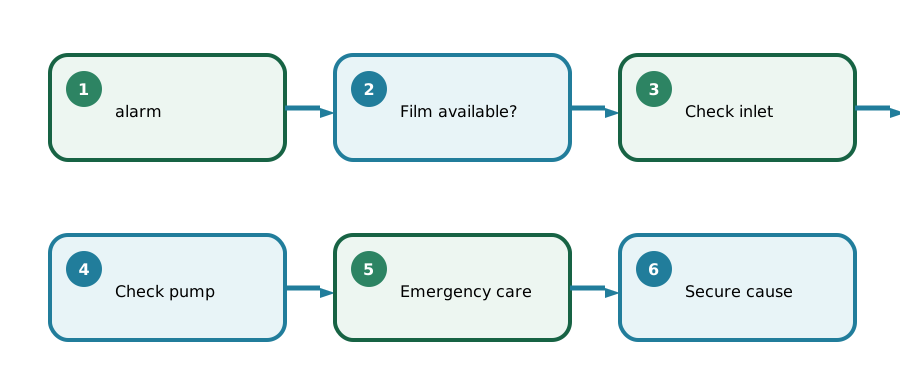
In the event of pump or power failure, NFT loses its water supply quickly. Alert, accessible replacement pump, safe water level, backup or bridging strategy and clear response pathways shall be established before loading. Even clogged individual inlets require recognition.
NFT stores little water in the root zone. Pump downtime can therefore become critical much faster than in systems with large solution volumes at the roots.
Redundancy can include replacement pump, automatic switching, emergency power, alarming or a defined manual bypass. The appropriate combination follows location, cultural value and achievable reaction time.
Alarms are actually tested. Replacement pumps are connected or ready with a suitable coupling. An emergency plan identifies those responsible, maximum response pathways and the order of action.
G06 · Failure management
Food safety
Food-safe materials, clean source water, controlled young plants, closed storage and traceable cleaning are part of the construction. Deposits can change cross sections, protect microorganisms and reduce cleanability.
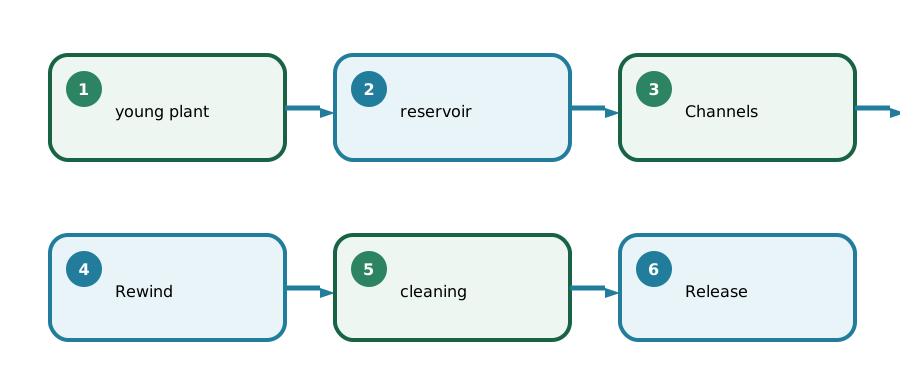
Recirculation not only distributes nutrients but can also transport organic load and pathogens between channels. Hygiene therefore begins in front of the reservoir and ends only after documented cleaning.
Food-safe, smooth and chemically resistant materials facilitate cleaning. Dead spaces, sinks which cannot be emptied and connectors which are difficult to access are avoided by design.
Plant remains are removed in a timely manner. cleaning and disinfectants are used according to material compatibility, concentration, exposure time and safe rinsing; Different means are not mixed uncontrollably.
G07 - Hygiene
Troubleshooting
Diagnosis begins with the pattern: a plant, a channel, a distribution group or the entire system. Spatial distribution limits causes faster than immediate pH or fertilizer corrections.
Measurement points at the distributor, channel end and return are predefined. Valves, cleaning openings and accessible lines make a fault site testable without dismantling the entire stock.
First, vital functions are ensured: film, level, pump and temperature. This is followed by instrumentation testing, water analysis and biological assessment. Only one justified change is made per step.
Routine
Daily visual inspection includes pump noise, film at the canal ends, return, level, leakage and plant response. Measurements are documented with time, measurement location, temperature and intervention. Calibration, cleaning and spare parts testing follow fixed intervals.
An operating routine combines visual inspection, measurement, cleaning and documentation. Only repeatable measurement conditions allow to distinguish real trends from measurement noise and daily cycle.
Checklists are established for daily, weekly and culturally recurring tasks. Border areas trigger defined controls; they do not automatically lead to a chemical correction.
A complete entry contains time, measurement location, temperature, pH, EC, level, visible flow, root state and performed measure. Calibrations and maintenance are tracked separately.
System selection
NFT performs a thin recirculating film. Kratky works passively with sinking stock and air root zone. DWC keeps roots in actively aerated solution. Aeroponics supplies them in the spray room. The systems differ fundamentally in waterway, oxygen supply, technology requirements and failure speed.
NFT minimizes solution volume directly at the root and requires continuous film flow. Kratky uses a passive supply, DWC a ventilated solution bath and aeroponics an intermittent or continuous spray supply.
The choice is based on culture, failure tolerance, available technology, maintenance competence, energy supply and hygiene strategy. No system is fundamentally superior regardless of the specific operation.
Mixed forms are assessed according to their actual root environment. A deeply flooded NFT channel or an intermittently operated pipe may have different properties than the original system designation suggests.
Source register
System definition, planning and operation are based on university, extension and international specialist sources. Figures from individual sources apply only in their plant and culture context.
Sources are separated by statement function: system definition, plant construction, nutrient guidance, cultural practice, hygiene and reliability. A source must carry the respective statement directly.
Measures or operating values are adopted with culture, channel form, development phase, climate and experimental conditions. Divergent source values are not averaged to a seemingly universal number.
For later updates, link, title, publisher and field of use are checked. Editorial derivations remain distinguishable from directly documented test results.