
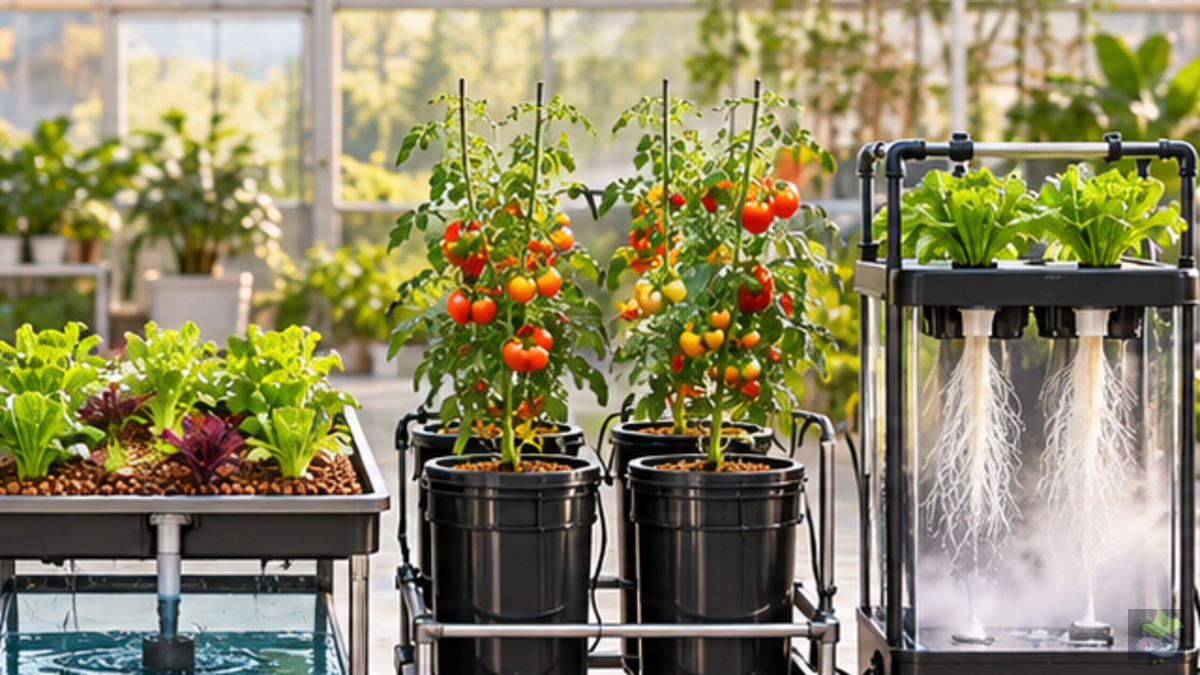
Hydroponic systems · drip watered substrate culture
Dutch bucket system
Supply large fruit crops individually, control drain and plan hydraulics, substrate and nutrient solution as a coherent operating system.
Technical chapter 01
Definition and delimitation
A Dutch bucket system is a drip-watered substrate culture with individually accessible plant containers. Each bucket receives nutrient solution via its own dropper; excess solution leaves the root zone via a structurally defined sequence. It can be collected and recirculated or removed separately.
Unlike NFT, the roots are not in a thin, continuous nutrient film. Unlike DWC, they do not permanently hang in a large volume of water. The substrate forms a time-variable reservoir for water and nutrients and at the same time keeps air pores open. Therefore, drip pulse, substrate and discharge height must fit together.
The individual containers facilitate culture change, control and exchange of individual plants. However, they do not automatically make the system fault-tolerant: A blocked dropper can dry out exactly one plant, while the remaining stock remains inconspicuous at first.
Technical chapter 02
System structure and material pathways
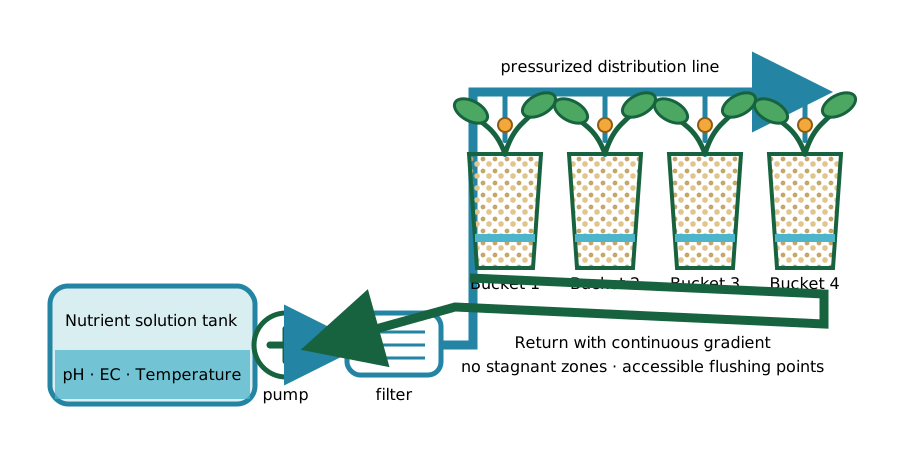
Tank, pump, filter, main line, pressure-controlled side lines, droppers, buckets and drain form a hydraulic chain. Pressure losses on the feed side and backlog on the discharge side act directly on the root zones.
The pump generates volume flow and pressure. The filter protects the small dropper openings. The main line distributes the nutrient solution among the rows; short capillaries or spaghetti tubes lead them to the plants. In the bucket, the solution is distributed in the substrate, wets the active root zone and temporarily displaces part of the pore air. Uncontained solution reaches the flow.
In the recirculating structure, this drain returns to the tank via an inclined collecting line. This returns not only water and nutrients, but also heat, roots, particles and possible pathogens. The return is therefore not a passive pipe, but a hygienic and hydraulically relevant plant part.
Technical chapter 03
Dutch Bucket and Bato Bucket
Dutch Bucket
Collective term for individually watered containers in series. Design, volume and flow differ depending on the manufacturer or own construction.
Bato Bucket
Commercial design with defined sequences or siphon sheets. The designation is not a guarantee for a certain hydraulics.
Technical chapter 04
Recirculating or drain-to-waste
Both configurations are technically possible. The selection changes water balance, nutrient guidance, hygiene requirements and monitoring effort.
Return to the nutrient solution tank
Excess nutrient solution flows back via collection line and gradient. Water and nutrient losses decrease, at the same time return flow, tank and hygiene must be monitored as a common system.
Nuclear control: reflux rate, tank EC, pH, temperature and hygienic condition.
Technical chapter 05
Vessel, insert and drain
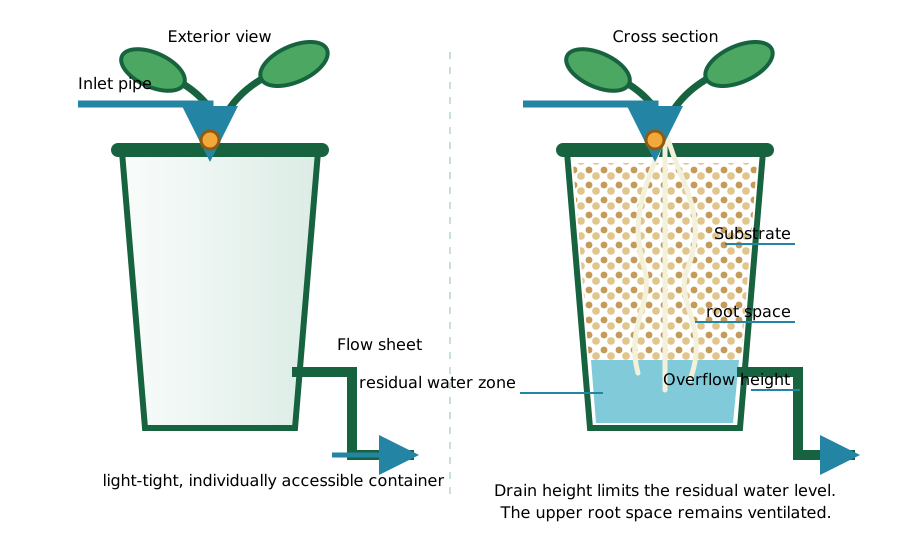
The container shall be light-tight, cleanable and stable. Its geometry affects substrate volume, rooting, stability and accessibility of the drain. A removable insert can separate substrate from the drainage region and facilitate control.
A drain bend or siphon retains a limited residual water zone at the bottom. This reserve can buffer short interruptions, but must not permanently saturate the entire bucket. Above the water level, the substrate needs enough air-filled pores for oxygen to reach the active root zone.
The run-off height is therefore a constructive manipulated variable: too low reduces the reserve, too high increases the saturated zone. Roots, fine substrate particles or a falsely leveled reflux can reduce the free cross section and raise the water level unnoticed.
- Inspection access without extension of the whole range
- Root protection before drainage and collection line
- Overflow path for blocked or falsely leveled buckets
- Lightproof wall against algae growth in the root zone
Chapter 06
Substrates and root zone
| Medium | Strengths | Planning risk |
|---|---|---|
| Perlite | high proportion of air pores, light | Yield, low inherent stability, dust |
| Cocoa | High water retention and buffering | Salt load, Ca/Mg binding, batch quality |
| Perlite coco | adjustable air-to-water household | Mixture must fit the impulse strategy |
| Bloating clay | Structurally stable and well draining | low water reserve, roots binding material |
Technical chapter 07
Droppers and distribution
The nominal dropper power is valid only within its intended pressure range. Pressure-compensating droppers can reduce altitude and line influences, but do not replace filtering or flow testing. Each bucket requires a uniquely assignable delivery point.
With a coarse substrate, two delivery points per bucket can improve spatial wetting. However, they simultaneously increase the total requirement and the number of possible defects. A distribution rod or drip ring distributes water evenly only when all openings are clear and the inlet pressure is sufficient.
The practical control is volumetric: several droppers at the beginning, middle and end of a row run for the same time window in measuring vessels. Not the printed nominal value, but the measured output and its dispersion describe the real state.
Technical chapter 08
Hydraulic design
The pump is not selected according to a catalogue indication at zero delivery height. Static altitude, line losses, filter dirt, valves and required minimum pressure at worst droppers belong in the operating point.
First, it determines how many droppers work at the same time and what real flow is required per dropper. Thereafter, line lengths, internal diameters, shaped pieces and height differences are detected. Long, thin lines increase friction losses; Unfavorable altitudes additionally change the available pressure.
The pump requires a reasonable reserve for filter loading and aging, but must not be operated permanently outside its suitable range by severe throttling. A manometer behind the filter and a measuring point at the end of the row make the calculation checkable during operation.
Technical chapter 09
Watering strategy
Start time, pulse duration and frequency are derived from substrate volume, water retention, root mass, radiation, temperature and culture stage. A rigid universal schedule is technically not resilient.
Short pulses are only precise if the pump, line and dropper quickly reach a reproducible operating state.
Chapter 10
Nutrient solution, pH and EC
Starting water, alkalinity, pH, electrical conductivity and culture-specific nutrient ratios are assessed together. substrate cultures do not have the buffering effect of a grown soil; Misdevelopments can therefore quickly become visible.
Technical chapter 11
Drain measurement and accounting
Feed and drain are measured simultaneously and on representative buckets. volume, pH and EC of the drain indicate whether pulses reach the root zone evenly; However, individual measurements must not be interpreted without culture, climate and substrate context.
Chapter 12
Crops and stock management
Dutch buckets are particularly suitable for long standing, ranking fruit crops such as tomato, cucumber, peppers or eggplant. Supporting structure, plant spacing, cutting, fruit load and accessibility are part of the system planning – non-additional accessories.
Chapter 13
Hygiene and congestion protection
Filtering depends on the water source, fertilizer, particle load and dropper opening. Line ends need flushing access. Biofilm, precipitates and introduced substrate particles are detected by inspection, pressure comparison and real delivery measurement.
Technical chapter 14
Monitoring and maintenance
| Control | Statement | Reaction |
|---|---|---|
| Pressure before/after filter | Increasing filter resistance | Clean the filter in a controlled manner |
| Drummer levy | Distributional uniformity | Localize outliers |
| Drain per reference bucket | root zone and impulse effect | Schedule not flat-rate change |
| Tank pH/EC/temperature | System trend | Evaluating trend and cause |
Chapter 15
Systematic limitation of disturbances
Chapter 16
Resilience and redundancy
Substrate offers a limited water reserve, but no blanket failure guarantee. Alert, replacement pump, accessible valves, documented hand watering and separate critical circuits are dimensioned according to culture value and drying rate.
Chapter 17
Suitability, limits and planning
Appropriate if ...
- large individual plants should be accessible separately
- Climbing and working rooms are planned
- Drain and droppers are regularly measured
Inappropriate if ...
- Filters and flushing points not accessible
- the drain cannot be reliably removed
- Watering without monitoring should only run by clock
Chapter 18
Specialist sources
- Q01: Oklahoma State University Extension Electrical Conductivity and pH Guide for Hydroponics. Open original source
- Q02: Oklahoma State University Extension Soilless Growing Mediums. Open original source
- Q03: Oklahoma State University Extension Principles of Small-Scale Aquaponics. Open original source
- Q04: USDA NRCS, Conservation Practice Standard 441 – Microirrigation. Open original source
- Q05: USDA NRCS, Engineering Practice Planning Guide: Microirrigation Systems. Open original source
- Q06: University of Minnesota Extension, Irrigation set-ups for specialty crops. Open original source
- Q07: University of Minnesota Extension, Irrigating strawberries. Open original source
- Q08: FAO, Good Agricultural Practices for greenhouse vegetable crops. Open original source
- Q09: FAO, Small-scale aquaponic food production. Open original source
- Q10: FAO AGRIS, Tomato production in different sizes of tezontle. Open original source