
Aquaponiksysteme · Multi Loop
Multi-Loop Aquaponics System
Eigenständige Fisch-, Pflanzen- und Behandlungskreisläufe mit kontrollierten Stoffübergaben und gezielter Nährstoffrückgewinnung.
Technically justify additional circuits
What is a multi-loop aquaponics system?
Multi-circuit aquaponics combines a stand-alone fish cycle, a stand-alone plant cycle, and at least one additional treatment or recovery circuit. Typically, separated fish solids are mineralized separately. After testing, the resulting liquid fraction is dosed into the plant cycle; Unsuitable residues are removed in a controlled manner.
Secure animal husbandry
Fish tanks, solids separation, biofilters, aeration and circulation work independently of plant and mineralization operations.
Deliver targeted nutrient solution
pH, conductivity, temperature, water level and supplements are regulated culture-specific.
Making solids usable
Sludge is collected, stabilized, mineralized and then separated into usable fractions and fractions to be discharged.
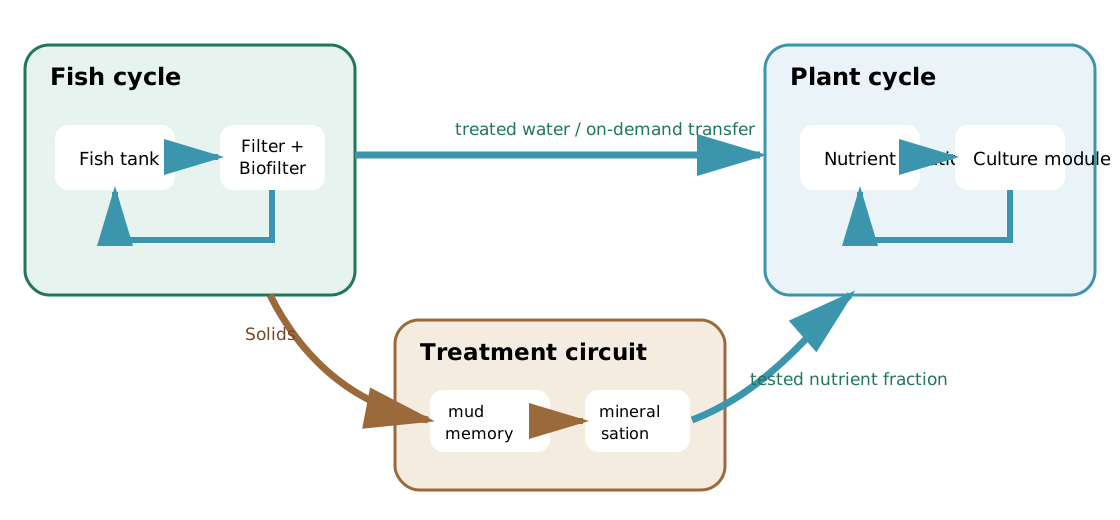
Balance water and substance paths separately
Water, solid and nutrient pathway
Multiple stocks
Each circuit has its own volume, evaporation, withdrawal, replenishment and safety reserve.
Own material flow
Mud contains water, organic carbon, nitrogen, phosphorus and minerals – but also unwanted particles and microbial risks.
Selective surrender
Only sufficiently characterized liquid fractions are dosed. Concentration, salt load and plant requirements determine the amount.
No zero waste promise
Unusable solids, rinse water, harvest, salt concentrates and used nutrient solution need defined discharge routes.
Three core processes plus handover technology
Required components
Fish production
- Fish tank and swamp
- mechanical solids separation
- Biofilter and degassing
- Circulation and oxygen supply
- Emergency ventilation, alarm and bypass
Crop production
- Nutrient solution container
- independent revolution
- NFT, DWC, substrate or vertical modules
- Root space aeration
- pH and nutrient dosage
Treatment and handover
- Sludge storage and thickening
- aerobic or anaerobic reactor
- Solid-liquid separation
- Measuring, mixing and dosing containers
- Backflow prevention and discharge
Do not confuse nitrification and mineralization
Biofiltration, solids treatment and oxygen
Secure dissolved nitrogen load
Ammonia oxidizers form nitrite, nitrite oxidizers – below Nitrospira – Nitrate. Nitrification consumes oxygen and alkalinity.
Capture particles early
Feces and leftover food are removed from the fish's circulation before they deplete oxygen, strain gills or clog filters.
Release bound nutrients
Microbial conversion can dissolve nutrients from organic matter. It neither replaces nitrification nor does it automatically replace complete plant fertilization.
Lay out the third circuit as a procedure
Mineralization and nutrient recovery
Characterize mud
Volume, dry matter, organic load, nutrients, salinity and origin are recorded.
Set process goal
Stabilization, volume reduction, phosphorus release, nitrogen conservation or generation of a dosable liquid fraction are different goals.
Separate factions
After treatment, liquid and residual solids are separated. Turbidity alone is not sufficient as a release criterion.
Dose minerals
The addition follows plant requirements, analysis, storage capacity and permissible salt or organic load.
Connect feed rate, plant requirements and reactor load
Design of a multi-loop system
Calculate fish load
Maximum feed rate, biomass, feed composition, temperature and target production determine solids, TAN and oxygen load.
Measure mud flow
Separation performance, flushing cycles, sludge volume and dry matter form the real reactor load.
Dimension the reactor
Residence time, mixing, aeration or gas management, temperature and storage volume are determined per process.
Balance plant needs
Culture, area, growth phase, climate, target EC and expected withdrawal determine the dosing strategy.
Limit handovers
Minimum and maximum quantities as well as material release criteria prevent overload and uncontrolled accumulation.
Check overall balance
Feed, supplements, water, crop, gas losses, sludge residue and discarded solution are regularly reconciled.
More measuring points, clearer process responsibility
Water quality, measurement and control
| Process area | Important metrics | Control task |
|---|---|---|
| Fish cycle | Oxygen, temperature, pH, TAN, nitrite, water level, flow | Independently ensure animal welfare, biofilter performance and safe circulation |
| Plant cycle | pH, EC, temperature, oxygen, water level, individual ions as required | Maintain nutrient solution appropriate to the culture and phase |
| Mud cycle | Volume, dry matter, pH, temperature, oxygen or redox, residence time | Check process conditions and discharge |
| mineralizate | Turbidity, EC, pH, relevant nutrients, residual organic load, hygiene parameters if applicable | Release, dilute, re-treat or discard |
| Overall system | Amounts of feed, water, nutrients, harvest and residues | Assess material balance, efficiency and accumulation risks |
Balancing resource usage against complexity
Advantages and limitations
Possible benefits
- Higher usability of nutrients from separated solids
- separate set points for fish, plants and treatment
- controlled dosage instead of direct sludge transfer
- independent scaling of production areas
- lower uncontrolled organic load in the plant cycle
- Better traceability of material flows
Limits and requirements
- additional containers, pumps, sensors and energy
- higher analysis, maintenance and documentation effort
- microbial processes react with a time delay
- Nutrient release may be unbalanced
- Residues and salt concentrates remain possible
- Incorrect operation at transfer points can affect several areas
Limit disruptions to the affected circuit
Incidents, biosecurity and redundancy
Reactor tips over
Lack of oxygen, incorrect load or storage for too long can cause odor, unwanted metabolites and process loss.
Minerals unsuitable
Excessive organic load, salt load or inappropriate pH require retention instead of automatic dosing.
Handover error
Valve or dosing errors are protected by physical isolation, quantity limitation and real flow control.
Power or air failure
Fish, plant and treatment cycles receive their own priorities, alarm limits and safe failure states.
- Secure the fish circuit and emergency ventilation first.
- Block material transfers and isolate the affected circuit.
- Evaluate readings, smell, color, temperature and operational log.
- Retain unsuitable fractions and treat them in a controlled manner.
- Carry out a restart gradually and with documented release.
For professional litigation
Suitability, system sizes and applications
Particularly suitable
For commercial or research-oriented systems with relevant sludge volume, independent process control and regularly available analytics.
Conditionally suitable
For smaller pilot plants when the additional circuit serves a clear learning, disposal or nutrient goal and can be managed safely.
Mostly not useful
For simple hobby systems when investment, monitoring and reactor maintenance significantly exceed the actual benefit.
Multi-loop is not automatically the most sustainable solution. The real recovery rate, use of energy and chemicals, waste route, operational safety and the avoided use of external resources are crucial.
Plant modules remain interchangeable consumers
Connect to media bed, NFT, DWC and vertical modules
Media bed
Can partially retain residual particles, but does not replace controlled solids and minerals treatment.
NFT
Requires particularly clear, low-particle solution; Organic residual load and biofilm must be strictly limited.
DWC
Large solution volume buffers dosages but requires aeration and control of solids and root hygiene.
Vertical modules
Delivery height, small nozzles and narrow channels increase the requirements for filtration and even nutrient distribution.
Architecture comparison
Differentiation from the other systems
| Architecture | Circular relationship | Core difference to System 5 |
|---|---|---|
| Fully coupled | common water circulation | no stand-alone sludge or recovery loop |
| Partially coupled / bypass | controllable plant branch in the common cycle | additional branch is not an independent treatment cycle |
| Coupled on demand | time- or measurement-controlled exchange | Controlling water flow does not replace separate mineralization |
| Completely decoupled, disposable | two separate main circuits without plant return | Solids are not necessarily recovered in a third loop |
| Multi-circuit aquaponics | Fish, plant and treatment cycle | additional process for solids treatment and nutrient recovery |
Compare all five system architectures
Does this aquaponics system fit your system?
Compare the water flow, controllability, technical complexity and typical operating conditions of all five system architectures.
Compare all five aquaponics systemsComprehensible technical basis
Specialist sources
- Goddek, S.; Keesman, K.J. (2020): Improving nutrient and water use efficiencies in multi-loop aquaponics systems, Aquaculture International 28, 2481–2490.
- Nishanth, D. et al. (2025): Current technologies for nutrient recovery in aquaponic systems: a review, Frontiers in Sustainable Food Systems.
- Lobanov, V. et al. (2021): Improving Plant Health Through Nutrient Remineralization in Aquaponic Systems, Frontiers in Plant Science.
- Goddek, S. et al. (2016): Navigating towards Decoupled Aquaponic Systems, Water 8(7), 303.
- Somerville, C. et al. (2014): Small-scale aquaponic food production, FAO Technical Paper 589.
- Palm, H.W. et al. (2018): Towards commercial aquaponics: a review of systems, designs, scales and nomenclature, Aquaculture International.