Microgreens anbauen
Vertical Farming and Multi-Tier Microgreen Production
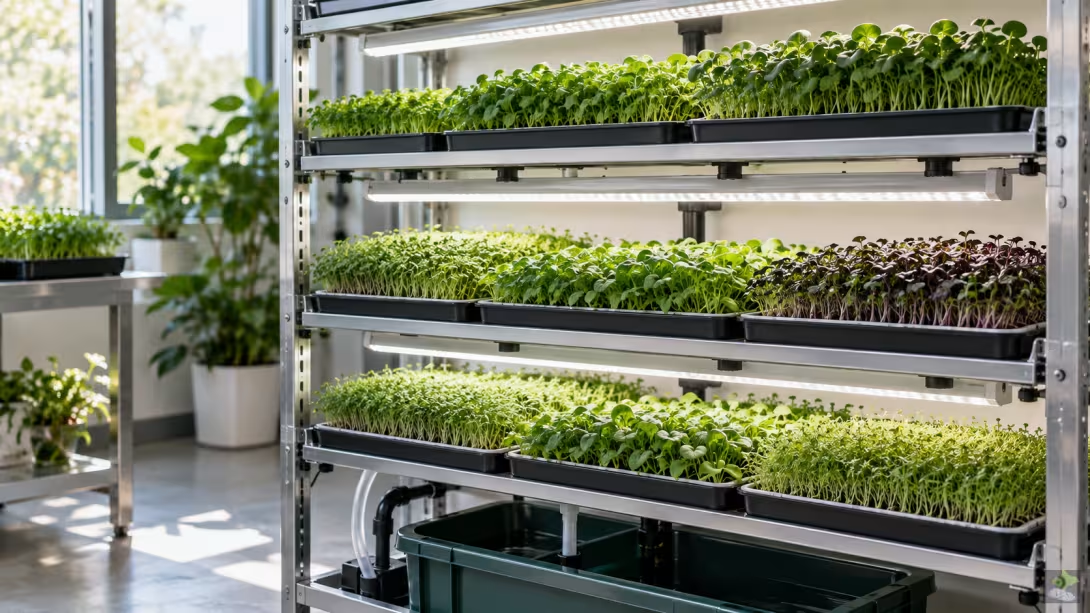
In multi-tier growing, shallow microgreen trays are cultivated on several illuminated shelving levels. The method multiplies the usable growing area and enables year-round production. It is not an irrigation technique in its own right: substrate mats, ebb-and-flow trays or other hydroponic methods can be used within the same rack.
Planning trays and racks
So-called 1020 trays, measuring approximately 53 × 28 cm, are common in professional production. More important than the nominal dimensions are sturdy food-safe trays, reliable drainage and sufficient working space between levels. Every level must remain accessible for sowing, inspection, harvesting and cleaning. Components carrying water are arranged so that no droplets fall onto crops below.
Plan lighting correctly
White full-spectrum LEDs allow visual quality control and support uniform crops. As a general starting range for microgreens, Virginia Tech recommends a daily light integral of approximately 9–16 mol/m²/day; the species, photoperiod, energy price and desired plant form may call for different values. A higher proportion of blue light can support more compact growth, but it is not the sole determinant of quality. Measured intensity and uniformity on every level are what matter.
Climate and air movement
Temperature and relative humidity should be measured not only in the room, but preferably at several rack levels. Virginia Tech gives a common indicative range of approximately 16–21°C and 50–70% relative humidity. Dense crops create a more humid microclimate directly above the canopy. Gentle horizontal air movement helps remove moisture; strong direct airflow dries out the edges.
Automation and sensors
- Timers and dimming for the lighting
- Logging temperature, humidity and light
- Monitoring tank level, pump operation and flow
- Controlling irrigation according to system conditions rather than solely by time
- Alerts for power, pump or climate-control failures
From trial to standard process
A new variety is first tested on one level. Seeding density, blackout phase, light, irrigation, fresh weight and rejects are documented. Only once several cycles are reproducible is the protocol transferred to additional levels. Measurements at a single point on the rack are insufficient because temperature, air movement and light can vary with height.
Strengths
- Efficient use of floor space
- Predictable year-round production
- Good conditions for data collection
Limitations
- Energy and capital requirements
- More complex cleaning and climate control
- Technical failures can affect several levels simultaneously