
Drought-Resilient Garden Design: Plant Selection, Soil Improvement and Mulching Strategies for Extreme Summers
Drought-Resilient Gardens Begin with the Site
Hot summers and prolonged dry periods present new challenges for gardens. However, a drought-resilient garden is not created simply by planting individual varieties advertised as particularly robust in arbitrary soil. What matters is the interaction between the site, soil structure, plant selection, ground cover and adapted irrigation.
The aim is not a garden that can always do without water. Newly planted perennials, shrubs and trees must first develop a viable root system. Only once they are well established can suitable plants withstand longer dry periods more effectively.
Drought tolerance does not mean that a plant can manage without irrigation immediately after planting. Plants suited to the site become resilient only after a successful establishment phase.
Assess Sun, Wind and Soil First
Before selecting plants, divide the garden into areas with different conditions. A fully exposed site in front of a sun-heated south-facing wall has different requirements from a bed in the dappled shade of a tree.
Factors to consider include:
- daily hours of sunshine and temporary shade,
- wind and drying air movement,
- slopes, depressions and possible drainage routes,
- soil type, organic-matter content and compaction,
- available rooting space,
- competition from existing trees, hedges and large shrubs.
Particularly dry areas often occur along house walls, beneath roof overhangs, on slopes and in densely rooted zones. Lower-lying areas, by contrast, may collect rainwater and remain moist for longer.
Assess the Existing Soil Correctly
Sandy soils
Water drains quickly through sandy soils, which often have only a limited storage capacity. Regular applications of mature compost can increase the organic-matter content and improve soil structure. Permanent ground cover also reduces direct evaporation.
Heavy, clay-rich soils
Heavy soils can store large amounts of water, but may absorb it only slowly when compacted or when the surface has dried out. Heavy rainfall and overly rapid irrigation may then run off across the surface. Gentle loosening, ground cover and irrigation in several intervals improve infiltration.
Indiscriminately mixing in small amounts of sand is not a reliable solution. Depending on the original soil, this can create an unfavourable mixture that compacts severely. Soil improvement should therefore be based on the soil’s actual condition.
Compacted areas
In compacted soil, rain penetrates the root zone less effectively. Water runs off the surface even though the soil beneath may remain dry. Paths should be clearly separated from planting areas. Deep interventions around the roots of established woody plants, however, must be carried out with care.
Use Organic Matter Purposefully
Compost and green manure help develop a stable soil structure. Organic matter promotes biological activity and can improve the absorption and retention of rainfall and irrigation water.
More is not automatically better. Highly nutrient-rich materials may encourage soft growth with high water requirements or overfertilise sensitive sites. Mature compost should be used according to need and in a way that suits the crop.
For drought-tolerant perennials from nutrient-poor habitats, soil that is too rich and permanently moist can even be detrimental. Soil improvement therefore does not mean converting every bed into the same humus-rich mixture.
Mulch Protects the Soil and Its Living Organisms
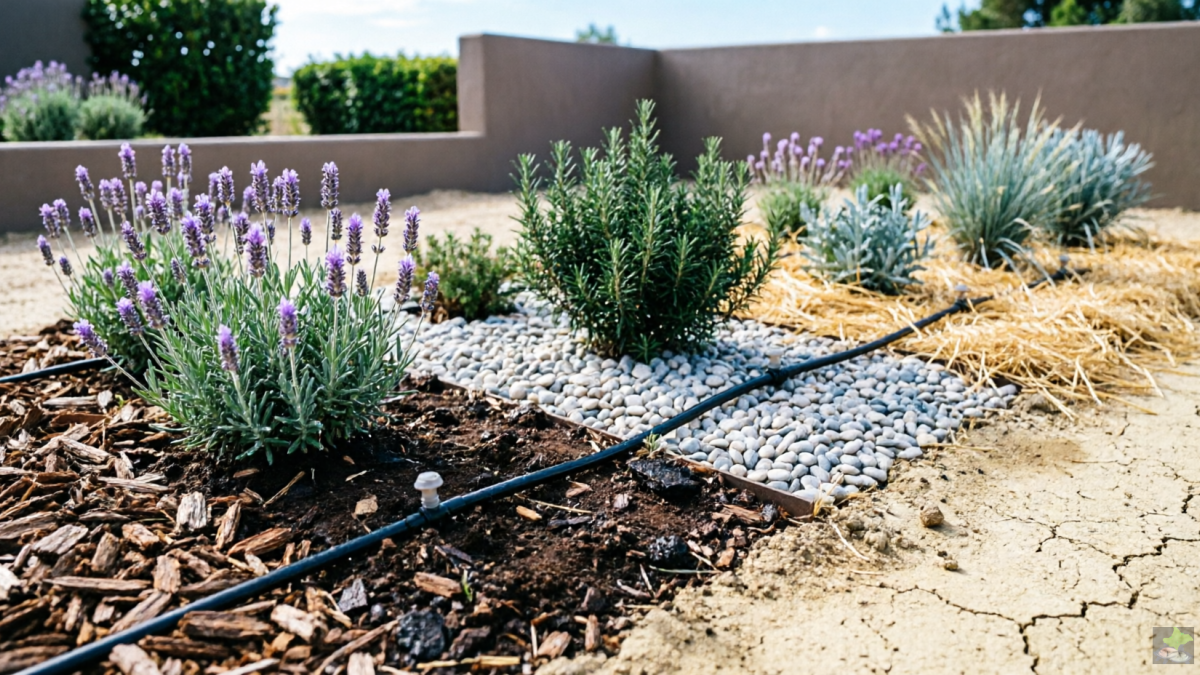
A layer of mulch shields the soil surface from direct sunlight and wind. It reduces evaporation and heating and protects against surface sealing and erosion. At the same time, it suppresses the growth of competing weeds.
Organic mulch
Depending on the crop, suitable materials for vegetable beds include wilted grass clippings, straw, leaves or shredded plant residues. The material should be applied loosely and must not begin to rot. Fresh grass clippings are best allowed to wilt first and then spread in a layer of appropriate depth.
Bark mulch is unsuitable for many vegetable beds. Its decomposition can temporarily tie up nutrients, and it does not suit every crop. It can, however, be useful around woody plants.
Mineral mulch
Gravel, chippings or other mineral materials can suit drought-adapted perennial plantings. They do not decompose and keep the soil surface open. Dark stones can, however, become very hot in full sun. The material, plants and location must therefore be compatible.
Keep Clear of Trunks and Plant Crowns
Mulch should not be piled directly against tree trunks, the bases of shrubs or sensitive plant crowns. Persistent moisture in these areas can promote rot and bark damage. Leaving a small clear area around the base of the plant prevents this so-called mulch volcano.
Select Plants for the Site, Not the Label
The term “drought-tolerant” is meaningful only when winter moisture, soil type, light and regional temperatures are also considered. Many Mediterranean plants tolerate summer drought but are sensitive to heavy, wet soils in winter.
Typical characteristics of drought-adapted plants include:
- small, narrow or finely divided leaves,
- silvery, hairy or waxy leaf surfaces,
- fleshy leaves or other storage organs,
- deep or widely branching root systems,
- rhizomes, tubers or bulbs that allow plants to survive adverse periods.
These characteristics are useful indicators, but they are no substitute for assessing the site.
Plant Examples for Sunny, Dry Areas
Depending on the region and soil, the following plant groups may be suitable for sunny, well-drained sites:
- lavender and other Mediterranean subshrubs,
- sage species and catmint,
- thyme and oregano,
- yarrow and golden marguerite,
- lamb’s ear and bluebeard,
- stonecrop and other suitable succulent perennials,
- drought-tolerant ornamental grasses,
- native wild perennials suited to the site.
A mixture of species is generally more stable than a large monoculture. Different flowering periods and growth forms also improve the food supply and habitat structure for insects.
Avoid invasive species and take regional recommendations into account when choosing plants. Native does not automatically mean drought-tolerant, and a non-native plant is not automatically unsuitable. Suitability for the site, ecological value and controllable spreading behaviour are what matter.
Establish New Plants Carefully
Even drought-tolerant plants must be watered thoroughly after planting. The root ball must not dry out completely during establishment. The length of time for which support is required depends on the species, plant size, season, soil and weather.
Autumn planting can allow many hardy perennials and woody plants to develop roots before the following summer. Species that are sensitive to cold, wet soil, however, are often better planted in spring.
Smaller, well-rooted young plants may sometimes adapt to a site better than very large specimens. Immediately after planting, large plants have abundant foliage but not yet a correspondingly extensive root system in the surrounding soil.
Water Less Often but Thoroughly
Frequent, shallow watering mainly moistens the uppermost layer of soil. Roots may then become concentrated in this shallow zone, which dries first in hot weather. Slower, thorough irrigation encourages roots to explore deeper soil layers.
Assess actual water demand by checking the soil and plants. A dry surface does not necessarily mean that the root zone is also dry. Conversely, a brief shower may moisten only the upper few centimetres.
Suitable time
Early morning is usually the best time. Evaporation is lower than during the midday heat, and leaves can dry during the day. If watering in the evening, avoid leaving foliage unnecessarily wet for long periods.
Deliver water directly to the roots
A watering can, drip irrigation or pipes laid close to the ground deliver water to the root zone more precisely than broad overhead watering. Drip systems must be checked regularly for blockages, leaks and even distribution.
On heavy soils and slopes, irrigation can be divided into several shorter cycles. Pauses allow the water time to infiltrate and reduce surface runoff.
Group Plants with Similar Water Requirements
Dividing the garden into irrigation zones avoids having to water drought-tolerant plants together with water-demanding crops. Vegetables, newly planted woody plants and established drought-tolerant perennials each receive separate areas.
Within each zone, light, soil and rooting depth should also be comparable. Even with the same plant species, a shaded bed may need considerably less water than a site beside a hot south-facing wall.
Collect Rainwater and Retain It on Site
Rainwater is well suited to garden irrigation and reduces demand for mains water. Water butts or larger tanks can collect roof runoff. Before use, consider the roofing material and possible contaminants. Germany’s Environment Agency points in particular to possible restrictions for certain metal and bitumen roofs.
Rainfall should be allowed to infiltrate on the property wherever possible. Unsealed surfaces, swales, planted infiltration areas and permeable paths slow runoff. During heavy rain, overflows must be designed so that buildings and neighbouring properties are not put at risk.
Review Lawn Areas Critically
Intensively maintained ornamental lawns require a great deal of water and care during dry summers. Not every lawn needs to be removed completely. It is, however, worth considering which areas are actually used for play, access or sitting.
Depending on the site, little-used areas can be replaced with species-rich meadows, ground-cover planting or perennial beds. Established lawns can be allowed to turn brown temporarily during dry periods. They often recover after sufficient rainfall.
Implement a Drought-Resilient Garden Plan Step by Step
- Document the site, light, wind, soil and water runoff.
- Divide planting areas according to similar water requirements.
- Address compaction and structural soil problems purposefully.
- Choose diverse plants that suit the site.
- Establish new plants thoroughly and do not allow them to dry out prematurely.
- Protect bare soil with suitable mulch or dense planting.
- Collect rainwater and retain precipitation on site wherever possible.
- Match irrigation to actual demand and check it regularly.
- Document failures, water use and plant development.
- Improve the plan after each season based on your observations.
Conclusion
A drought-resilient garden is not a gravel garden with a few supposedly maintenance-free plants. It is a system adapted to its site that protects the soil, retains rainwater, combines suitable plants and uses water purposefully.
The greatest effect comes from several coordinated measures: suitable plants, a sound establishment phase, stable soil structure, ground cover, irrigation according to need and the use of rainwater. Together, these keep the garden functional, varied and ecologically valuable even during hot summers.
Sources and Further Information
- Bavarian State Research Centre for Viticulture and Horticulture: Water management in the garden
- German Federal Centre for Agriculture Information: Mulching—ground cover in the garden
- German Federal Centre for Agriculture Information: Watering plants correctly and saving water
- German Environment Agency: Advice on the sustainable use of rainwater
- Royal Horticultural Society: Drought-resistant gardening
- Royal Horticultural Society: Watering plants correctly