
NFT or DWC: Why There Is No Universal Winner
NFT or DWC: Why There Is No Universal Winner
Nutrient Film Technique (NFT) and Deep Water Culture (DWC) are among the most common methods for hydroponic leafy-vegetable production. Both systems can deliver high, consistent yields. Which method is more suitable, however, depends on the specific operating conditions.
Relevant factors include the crop, climate, system size, planting density, pumping and aeration technology, nutrient-solution management, available space and the required level of operational reliability. Claims such as “DWC always requires less energy” or “NFT always produces higher yields” therefore cannot be applied reliably to every installation.
NFT and DWC should not be compared using a single metric. A sound decision considers yield, energy, water, space, labour requirements and resilience together.
How the two systems work
Nutrient Film Technique
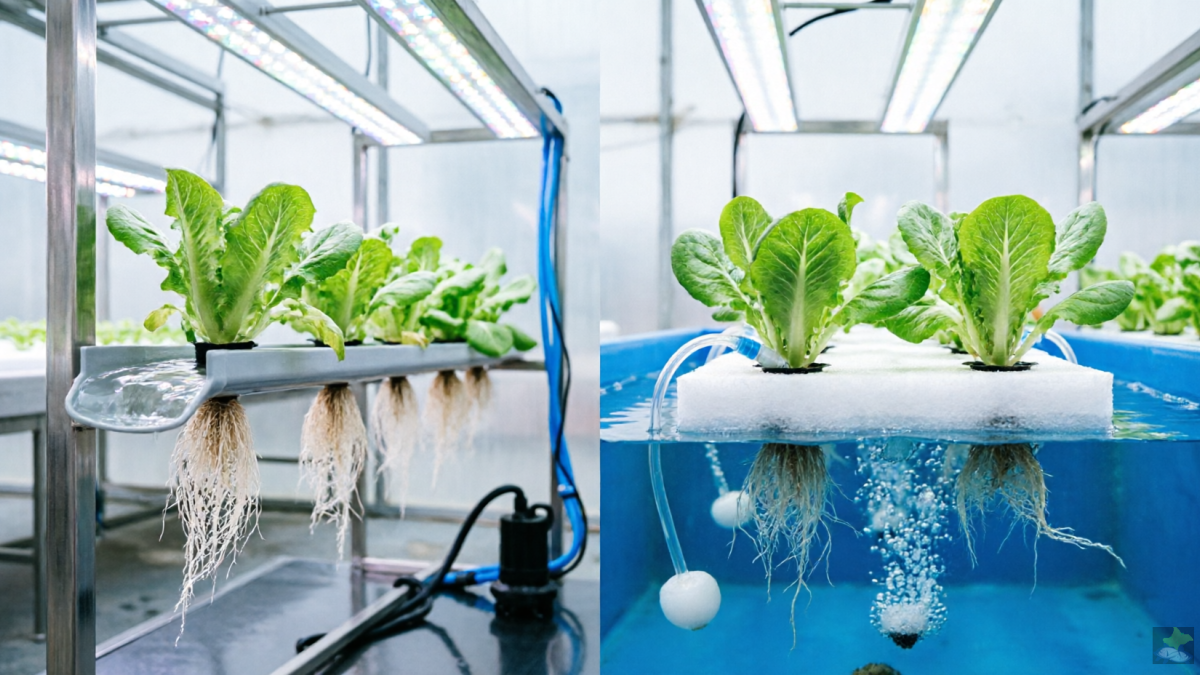
In NFT, a comparatively thin film of nutrient solution flows through gently sloping growing channels. Plants sit in openings on top of the channels. Part of the root system is wetted by the solution while other roots remain in contact with the air.
The nutrient solution collects in a reservoir and is pumped back to the channels. The system therefore depends on consistent flow and unobstructed return lines.
Deep Water Culture
In DWC, plants are generally held on floating rafts or fixed supports, with their roots continuously suspended in a larger volume of nutrient solution.
Because the roots are submerged, the solution must receive a reliable oxygen supply. Air pumps, distribution lines and diffusers are normally used for this purpose. Water movement and uniform aeration are central parts of the system.
Key differences at a glance
Root zone and oxygen supply
NFT:Roots occupy growing channels through which nutrient solution flows. Some roots have direct contact with the air, although flow and reservoir condition remain important.
DWC:Roots remain suspended in a larger volume of water. Active and uniform aeration is therefore essential.
Temperature and use of space
NFT:Growing channels and their small local water volumes respond comparatively quickly to temperature changes. Narrow, modular channels allow flexible use of space.
DWC:Larger water masses can buffer temperature changes more effectively. Tanks and access aisles often require a larger continuous area.
Failure risks
NFT:An interruption to flow can leave roots dry relatively quickly. Pumps, supply lines and returns require reliable monitoring.
DWC:Aeration failure can cause an oxygen deficit in the root zone. Air pumps and diffusers must be checked regularly.
Cleaning and maintenance
NFT:Growing channels, supply lines and returns must be inspected and cleaned.
DWC:Tanks, diffusers and areas with low water movement must be monitored and cleaned.
Yield: results depend on the season and system
Scientific comparisons do not produce a uniform picture. A 2024 study published by the US Department of Agriculture compared NFT and DWC for lettuce under different seasonal conditions. In that study, DWC performed better for fresh mass and nutrient-solution characteristics during the autumn crop, while NFT achieved a slightly higher yield in summer.
Another study published in 2025 found higher lettuce yields and better water use in the DWC system tested. At the same time, DWC had the lowest energy efficiency and used space less favourably. This demonstrates that a larger harvest does not automatically represent the best overall performance.
Cultivar, temperature, available light, plant spacing, nutrient supply and harvest timing can substantially alter the outcome. A value from one experimental installation should therefore not be adopted uncritically as a planning value for another.
Energy use: consider pumping, aeration and climate together
In NFT, electricity is used mainly to circulate the nutrient solution. Actual power consumption depends on pumping head, pipe losses, pump efficiency and operating time.
DWC also requires water movement as well as reliable aeration. The number and depth of tanks, diffusers, air lines and pressure losses determine the demand placed on the air pumps.
In a comparative study published in 2023, NFT achieved greater electrical-use efficiency than DWC under the conditions tested. This contradicts blanket claims that DWC always requires less energy, but it remains a result of that specific experimental setup.
In heated or artificially lit systems, climate control and grow lighting may account for a much larger share of energy use than water pumps. A fair comparison must therefore measure all relevant consumers over their actual operating times.
Water use: recirculation alone is not decisive
Both NFT and DWC recirculate their nutrient solution. The greatest unavoidable water use normally results from plant uptake and transpiration. Further losses arise from evaporation, leaks, cleaning, draining and necessary replacement of nutrient solution.
A larger water reserve does not automatically mean greater ongoing consumption, just as a smaller system volume does not guarantee better water efficiency. The meaningful measure is the quantity of water replenished or discarded per kilogram of marketable produce over a complete crop cycle.
Operational reliability and maintenance
Risks with NFT
If the circulation pump fails or a supply line becomes blocked, affected plants no longer receive water. This can quickly become critical in warm weather and with large root masses. Alarms, spare pumps and careful channel inspections improve operational reliability.
Risks with DWC
If aeration fails, the oxygen supply to submerged roots declines. Risk increases in warm water and with a high root or microbial load. Air pumps, non-return valves, diffusers and backup power must therefore be included in maintenance planning.
Both systems require documented inspections. These should cover at least water level, temperature, pH, electrical conductivity or nutrient concentration, pump operation, flow, aeration and root health.
Special considerations in aquaponics
In aquaponic systems, solids and microorganisms enter the water circuit alongside dissolved nutrients. NFT channels can be impaired by inadequately removed solids and large root masses. Effective solids separation before the channels is therefore particularly important.
DWC tanks can also work well in aquaponics, but likewise require controlled solids management, adequate water movement and uniform oxygen supply. Deposits beneath planting rafts or in low-flow zones should be avoided.
The FAO describes both NFT and DWC as possible aquaponic cultivation methods. Selection should suit the fish stocking load, filtration technology, crop and available maintenance capacity.
When might NFT be the right choice?
- when a compact channel structure that can be expanded modularly is required,
- when mainly fast-growing crops with manageable root volumes are grown,
- when flow and return lines can be monitored reliably,
- when the available growing area needs to be used as efficiently as possible,
- when individual channels can be cleaned and replaced efficiently within the operation.
When might DWC be the right choice?
- when a larger water mass is desirable to stabilise the root environment,
- when lettuce or similar crops are produced on floating rafts,
- when sufficient space is available for tanks and access aisles,
- when aeration, water movement and emergency provision can be designed reliably,
- when planting rafts are to be moved through standardised workflows.
How to evaluate the decision in your own operation
A controlled pilot trial is advisable before making a larger investment. NFT and DWC should be tested using the same cultivar, comparable plant age, similar planting density and the same nutrient solution wherever possible.
At least the following data should be recorded for each crop cycle:
- marketable fresh mass and rejects,
- crop duration and planting density,
- water replenished and discarded,
- measured electricity use for pumping and aeration,
- labour time for monitoring, cleaning and harvesting,
- root-zone temperature and oxygen supply,
- malfunctions, pump failures and blocked pipes.
Only these operational data permit a robust assessment. A system may, for example, produce a higher yield while also requiring more space, energy or labour.
Conclusion
NFT and DWC are effective cultivation methods, but follow different technical principles. NFT offers a flexible channel structure and can use space efficiently. DWC provides roots with a larger volume of water but requires continuously reliable aeration.
Scientific findings vary with season, crop and experimental system. Rather than declaring a universal winner, operators should choose the system that offers the best balance of yield, energy, water, space, labour and resilience under their own conditions.
Sources and further information
- USDA: Comparative evaluation of deep water culture and nutrient film technique for lettuce production
- HortScience: Resource-use efficiencies of hydroponic lettuce production systems
- Gillani et al.: Comparative energy analysis of hydroponic systems
- FAO: Small-scale aquaponic food production
- Savvas and Gruda: Application of soilless culture technologies in the modern greenhouse industry