
CHAPTER 01 · 7 MIN READ
Omega-3 and Omega-6 Fatty Acids
Biochemical Interactions, Cellular Integration and Strategies for Improving Fatty-Acid Intake
Section: Health | Vida Vertical
Summary
The polyunsaturated omega-3 and omega-6 fatty acids are essential components of human nutrition. They contribute to cell-membrane structure and serve as precursors for lipid mediators that regulate inflammation, vascular function and resolution. Their effects cannot be reduced to omega-6 being inflammatory and omega-3 anti-inflammatory: both families generate diverse signalling molecules and are physiologically necessary. This article explains their biochemical interactions, the limited conversion of plant-derived alpha-linolenic acid (ALA) to EPA and DHA, and practical ways to secure adequate intake. It also considers microalgae cultivation as a potential sustainable source of long-chain omega-3 fatty acids.
1. Introduction: Essential Lipids
Fats are far more than energy stores or insulation. At cellular level they influence the fluidity, permeability and signalling of phospholipid bilayers. Polyunsaturated fatty acids (PUFAs) are distinctive because humans cannot introduce double bonds beyond certain positions in the carbon chain. Linoleic acid (omega-6) and alpha-linolenic acid (omega-3) must therefore be obtained from food.
2. Biochemical Foundations and Cellular Integration
Omega-3 and omega-6 fatty acids exert many effects after incorporation into membrane phospholipids. When cells are activated or damaged, phospholipase enzymes can release them for conversion into eicosanoids and other lipid mediators involved in inflammation, vascular tone, platelet function and resolution.
2.1 Omega-6 Fatty Acids: Essential Signalling Substrates
Linoleic acid is the principal dietary omega-6 fatty acid and can be converted, to a limited extent, into arachidonic acid. Arachidonic acid gives rise to prostaglandins, thromboxanes and leukotrienes with varied—and not uniformly pro-inflammatory—effects. These mediators participate in immune defence, haemostasis, wound healing and adaptation to exercise.
2.2 Omega-3 Fatty Acids: Modulators of Inflammation and Resolution
The long-chain omega-3 fatty acids EPA and DHA interact with some of the same metabolic pathways as arachidonic acid. They give rise to eicosanoids and specialised pro-resolving mediators, including resolvins, protectins and maresins, which can help regulate and resolve inflammatory responses. DHA is also an important structural component of neural and retinal membranes.
3. The Omega-6-to-Omega-3 Ratio: Context and Limitations
The two fatty-acid families share parts of their elongation and desaturation pathways, but health cannot be inferred from their dietary ratio alone. Absolute intakes, food sources and overall dietary pattern matter.
Claims that ancestral diets consistently had a ratio of 1:1 to 2:1 and that modern diets universally reach 15:1 to 20:1are estimates that vary greatly by population and methodology.
Some organisations have historically cited ratios such as 5:1, but current evidence does not support one universal target ratio. Linoleic acid does not inherently cause systemic inflammation; replacing saturated fat with polyunsaturated fat can improve cardiovascular risk. The practical priority is adequate omega-3 intake alongside a balanced diet.
4. Physiological Effects of Adequate Omega-3 Intake
Adequate long-chain omega-3 intake is associated with several physiological effects, whose magnitude depends on dose and population:
- Cardiovascular Effects: EPA and DHA lower triglycerides at pharmacological doses and may modestly affect blood pressure; clinical cardiovascular benefits vary by preparation, dose and baseline risk.
- Metabolic Effects: Omega-3 fatty acids influence membrane and signalling pathways, but they should not be assumed to redirect glucose into muscle or reliably improve insulin sensitivity in every person.
- Endocrine Effects: Evidence does not support presenting omega-3 intake as a reliable way to lower chronically raised cortisol or prevent visceral-fat gain.
- Recovery and the Nervous System: DHA contributes to neural structure, while omega-3 supplementation may modestly affect exercise-related soreness or recovery in some settings. Results remain heterogeneous and do not replace appropriate training, sleep and nutrition.
For generally healthy adults, many European recommendations are around 250 mg of EPA and DHA per day . Doses of 2.0 to 3.0 g of EPA/DHA are used in particular clinical or research settings but are not a universal target for athletes or the general population and should be considered with professional guidance.
5. The Conversion Issue: ALA Versus EPA and DHA
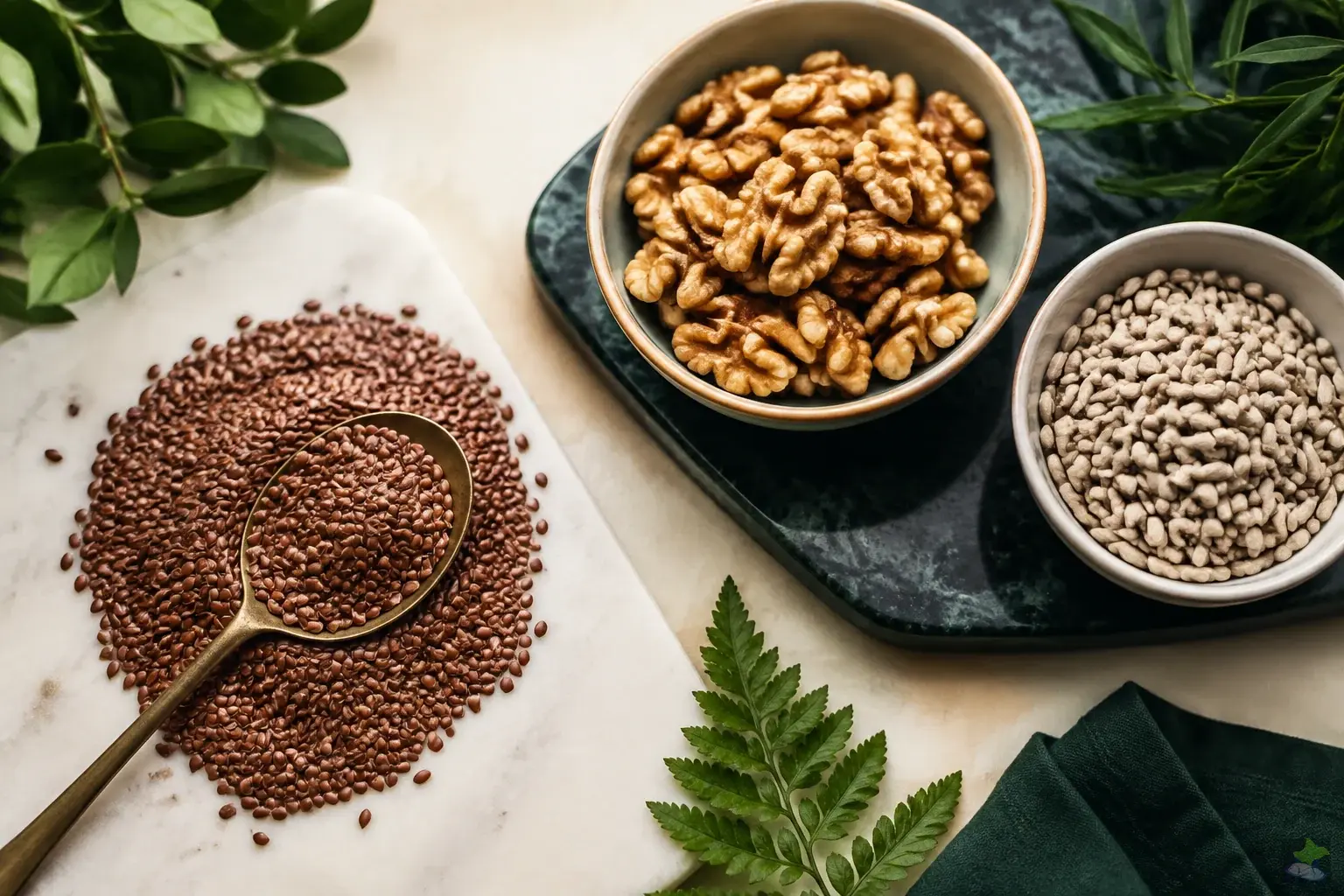
Flaxseed, chia seeds, walnuts and hemp oil supply alpha-linolenic acid (ALA), an essential 18-carbon omega-3 fatty acid. They make a valuable contribution, but ALA is not physiologically identical to EPA or DHA.
ALA can be elongated and desaturated to EPA and then DHA. Conversion varies by sex, genetics, background diet and measurement method and is generally limited:
- Reported conversion of ALA to EPA is often around 5 to 10 percent, although estimates vary.
- Conversion to DHA is usually below 5 percent and can be very low in some studies.
Because conversion is limited, people who eat no fish may consider a verified algae-derived EPA/DHA product, especially when individual requirements or clinical circumstances justify it. This does not make ALA-rich foods inadequate or unimportant.
6. Practical Strategies for Improving the Fatty-Acid Profile
A practical approach focuses on food quality and adequate intake rather than forcing a particular ratio:
- Choose Fats Deliberately: Use olive or rapeseed oil and include nuts and seeds. There is no need to eliminate sunflower, safflower or maize oil categorically; overall quantity, processing and the balance of the whole diet matter.
- Obtain EPA and DHA Directly:
- Omnivorous Diet: Include appropriately sourced oily fish such as salmon, mackerel, herring or sardines in line with local guidance.
- Plant-Based Diet: A verified algae oilcan supply EPA and/or DHA directly. Reputable products are purified and tested; neither fish oil nor algae oil should be described as automatically free of every contaminant.
7. Relevance to Vida Vertical: Lipid Production in Controlled Systems
From the producer’s perspective, controlled cultivation may contribute to sustainable lipid sources, but feasibility differs substantially between microalgae, oilseed crops and ordinary hydroponic vegetables:
1. Cultivating Microalgae in PhotobioreactorsMarine food webs ultimately obtain long-chain omega-3 fatty acids from microorganisms, including microalgae. Species such as Schizochytrium sp. and Nannochloropsiscan be cultivated under controlled conditions for DHA- or EPA-rich biomass and oils. Light, temperature, nutrient supply and processing require specialised management. Such production normally uses dedicated photobioreactors rather than standard aquaponic loops, and product safety must be validated.
2. Stress Responses and Lipids in Oilseed CropsFlax and hemp synthesize ALA in their seeds. Environmental conditions can affect seed-oil composition, but claims that UV-B or osmotic stress reliably “upregulates” nutritionally useful ALA in hydroponic production require crop-specific evidence and must be balanced against yield, energy use and plant health.
3. Sprouts and Microgreens as a Food MatrixFresh flax or chia sprouts provide a whole-food matrix, although germination changes lipid content and food-safety controls are essential. Antioxidants may help limit oxidation, but sprouts should not be claimed to prevent rancidity completely; seeds and oils still require appropriate storage.
8. Conclusion
Omega-3 and omega-6 fatty acids are essential partners, not opposing substances of which one should be eliminated. Both contribute to membranes and signalling. The strongest practical guidance is to ensure adequate ALA and, where appropriate, EPA/DHA while choosing a balanced pattern of mostly unsaturated fats—not to pursue an assumed universal ratio.
Fresh, minimally processed foods, ALA-rich seeds and verified fish- or algae-derived EPA/DHA sources can meet different dietary needs. Controlled microalgae production is promising, but it requires specialised systems and quality assurance rather than simple integration into any aquaponic setup.
Note: This article provides general scientific information and does not replace medical or dietetic advice. People with health conditions or those taking anticoagulants should discuss high-dose omega-3 supplements with a qualified clinician.
References:
- Simopoulos, A. P. (2016). An Increase in the Omega-6/Omega-3 Fatty Acid Ratio Increases the Risk for Obesity. Nutrients, 8(3), 128.
- Calder, P. C. (2016). Omega-3 fatty acids and inflammatory processes: from molecules to man. Biochemical Society Transactions, 44(5), 1107–1117.
- DiNicolantonio, J. J. & O’Keefe, J. H. (2018). Importance of maintaining a low omega-6/omega-3 ratio for reducing inflammation. Open Heart, 5(2), e000946.
- Brenna, J. T., et al. (2009). alpha-Linolenic acid update: 2009. American Journal of Clinical Nutrition, 90(3), 799S–805S.
- German Nutrition Society (DGE): D-A-CH reference values for nutrient intake. www.dge.de
Author: Uwe | Vida Vertical – Health
EXPLORE RELATED TOPICS
You may also be interested in
Macronutrients and Calorie Requirements
Physiological Foundations, Calculation Methods and Practical Application

Dietary Fibre
Biochemical Classification, Physiological Mechanisms and Preventive Relevance
Dietary Fats
Biochemical Classification, Physiological Functions and Evidence-Based Intake Recommendations