
CHAPTER 01 · 7 MIN READ
Lipid Metabolism and Dietary Fats
Cellular Functions, Fatty-Acid Classification and Hormonal Regulation

Section: Health | Vida Vertical
Summary
Fats are one of the three energy-providing macronutrient groups and, despite providing about 9 kcal per gram, do far more than supply calories. Lipids form cell membranes, cholesterol serves as a precursor for steroid hormones and dietary fat supports absorption of fat-soluble vitamins. This article classifies fatty acids by degree of unsaturation, explains the nuanced roles of omega-3 and omega-6 fatty acids and presents evidence-based intake principles without imposing unsupported sex-specific minimums. It also examines the practical limits and potential of producing microalgae and oilseeds in controlled systems.
1. Introduction: Reassessing Dietary Fat
Dietary fat is still sometimes portrayed as inherently fattening or harmful. That view is not scientifically defensible. Lipids are necessary for membrane integrity, essential-fatty-acid supply and absorption of vitamins A, D, E and K, while adequate energy availability supports endocrine function.
Health depends on the quantity, sources and broader dietary context of fat—not on pursuing a single “ideal” fatty-acid ratio. Omega-6 fatty acids are essential and not inherently inflammatory; replacing saturated fat with unsaturated sources generally benefits cardiovascular risk.
2. Physiological Functions of Dietary Fats
2.1 Energy Storage and Energy Density
Adipose tissue stores energy for later use. Fat provides approximately 9 kcal per gram, more than twice the energy of protein or carbohydrate at about 4 kcal per gram. This density can be useful or require portion awareness depending on a person’s needs.
2.2 Endocrine Regulation
Cholesterol is a precursor for steroid hormones, but dietary fat is not the obligatory direct substrate for all hormone synthesis because the body also synthesises cholesterol. Very low energy availability and highly restrictive diets can impair reproductive and endocrine function, particularly in susceptible athletes, but effects cannot be assigned to fat intake alone.
2.3 Structural Integrity of Cell Membranes
Every cell has a phospholipid bilayer. Its fluidity, permeability and signalling reflect fatty-acid composition shaped by both diet and endogenous metabolism; daily dietary fatty acids do not simply determine membrane properties one-to-one.
2.4 Absorption of Fat-Soluble Vitamins
Vitamins A, D, E and K require normal digestion, bile and micelle formation for efficient absorption. Some dietary fat in a meal can improve absorption, but a single low-fat meal does not inevitably cause deficiency.
3. Biochemical Classification of Fatty Acids
Fatty-acid structure, including chain length and number and position of double bonds, influences metabolism, oxidation and cooking behaviour.
3.1 Saturated Fatty Acids
Saturated fatty acids contain no carbon–carbon double bonds. Their relative oxidative stability varies with the whole fat and cooking conditions; lipid oxidation is still possible. Nutritionally, habitual replacement of some saturated fat with unsaturated fat is generally preferable to selecting cooking fats by saturation alone.
3.2 Monounsaturated Fatty Acids
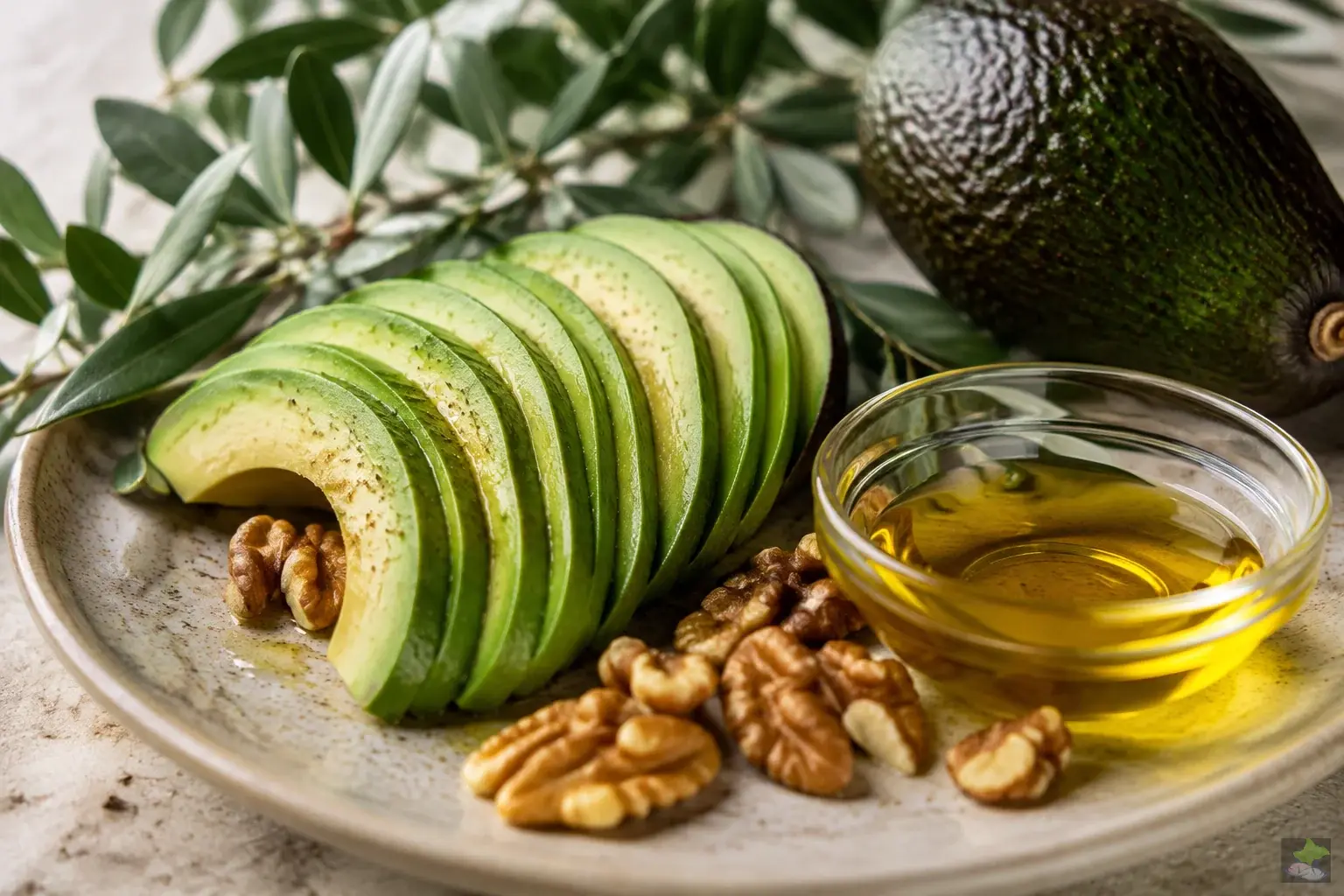
Monounsaturated fatty acids contain one double bond and contribute to structural and metabolic functions. Major sources include olive and rapeseed oils, avocados and many nuts.
3.3 Polyunsaturated Fatty Acids
Polyunsaturated fatty acids contain two or more double bonds and include the essential linoleic and alpha-linolenic acids. They are more oxidation-sensitive, but appropriate polyunsaturated oils can still be used in cooking according to their refinement and smoke point. Omega-3 and omega-6 are the main families.
4. Omega-3 and Omega-6: Interacting Pathways in Inflammatory Regulation
4.1 Incorporation Into Cell Membranes
Polyunsaturated fatty acids can be incorporated into membrane phospholipids and released by phospholipases for conversion into eicosanoids and other lipid mediators involved in inflammation, vascular tone, platelet function and resolution.
Omega-6-derived mediators are not uniformly inflammatory, nor are omega-3-derived mediators uniformly anti-inflammatory. Both families generate molecules with context-dependent actions and both are physiologically required.
4.2 No Universal Optimal Ratio
Omega-3 and omega-6 fatty acids participate in overlapping pathways, but reducing their biology to opposing directions is misleading. A high intake of linoleic acid has not been shown to cause systemic inflammation by itself.
Estimates of ancestral or contemporary ratios vary greatly, and there is no universally accepted target of 1:1, 2:1 or 5:1. Practical guidance is to ensure adequate omega-3 and favour unsaturated fats overall rather than attempting to engineer a numerical ratio.
4.3 EPA and DHA: Long-Chain Omega-3 Fatty Acids
EPA and DHA contribute to cell membranes and lipid-mediator pathways. Pharmacological doses can lower triglycerides; other effects on blood pressure or inflammation vary. Evidence does not justify claiming that 1–3 grams daily universally lowers cortisol, optimises insulin sensitivity or supports hormone production. Many European recommendations for healthy adults are around 250 mg per day, with higher doses reserved for specific indications.
5. Evidence-Based Intake Recommendations
5.1 Intake Floors and Energy Availability
There are no universally validated sex-specific minimums in grams per kilogram that guarantee endocrine function. Fat intake must provide essential fatty acids, enable a varied diet and fit total energy requirements:
- Men: No universal absolute minimum of 0.5 g/kg applies to every adult.
- Women: No universal absolute minimum of 0.7 g/kg applies to every adult.
Persistently low energy availability can impair reproductive, skeletal and endocrine health. Assessment should consider total energy, training, body composition, symptoms and dietary quality rather than one fat formula.
5.2 Practical Intake for Active People
A daily range such as 0.8 to 1.2 g per kg body weightmay work as a planning option for some active adults, but it is not a universal optimum. Dietary guidelines often express total fat as a percentage of energy and emphasise fat quality.
5.3 Quality Criteria
Useful priorities include:
- Favouring unsaturated sources while limiting industrial trans fats and moderating saturated fat
- Including ALA-rich foods and, where appropriate, fish or verified algae-derived EPA/DHA
- Using a variety of oils rather than categorically eliminating omega-6-rich oils
- Choosing cooking fats according to the whole oil, refining and temperature—not assuming saturated fats cannot oxidise
6. Relevance to Vida Vertical: Lipid Sources From Controlled Production
Controlled cultivation can complement a sustainable lipid strategy, although leafy hydroponic crops supply little fat and specialised lipid production has distinct requirements:
Microalgae as Direct Sources of Long-Chain Omega-3: Microalgae sit at the base of aquatic omega-3 food webs. Species or organisms such as Nannochloropsis and Schizochytrium can produce EPA- or DHA-rich biomass and oils in dedicated controlled systems. Food-grade production requires validated species, contaminant controls and downstream processing; it is not automatically regional, contaminant-free or compatible with a standard aquaponic loop.
Oilseeds From Controlled Cultivation: Flax and hemp provide ALA and can be grown in suitable environments. Mature seed production requires considerable space, light and processing, so regional field cultivation may be more efficient than indoor hydroponics. Light and nutrition can influence composition but do not guarantee a higher lipid content.
Fat-Soluble Vitamins From a Vertical Garden: Leafy vegetables can supply vitamin K1 and provitamin A. Combining them with a modest amount of an appropriate oil or another fat-containing food can improve carotenoid absorption; the crop’s hydroponic origin is not required for this benefit.
7. Conclusion
Dietary fats are essential, complex nutrients involved in membranes, energy storage, signalling and absorption of fat-soluble vitamins. The relevant question is how much and which sources suit the person’s total diet—not whether fat should be consumed at all.
A sound strategy emphasises unsaturated fats, essential fatty acids and adequate energy while avoiding unsupported universal ratios or hormonal thresholds. Fresh plants from controlled cultivation can complement meals, and specialised algae or oilseed production may supply lipids when it is technically and environmentally appropriate.
Note: This article provides general scientific information and does not replace medical or dietetic advice. People with metabolic disease or taking anticoagulants should discuss major dietary changes or high-dose omega-3 supplements with a qualified clinician.
References:
- Calder, P. C. (2016). Omega-3 fatty acids and inflammatory processes: from molecules to man. Biochemical Society Transactions, 44(5), 1107–1117.
- Simopoulos, A. P. (2016). An Increase in the Omega-6/Omega-3 Fatty Acid Ratio Increases the Risk for Obesity. Nutrients, 8(3), 128.
- DiNicolantonio, J. J. & O’Keefe, J. H. (2018). Importance of maintaining a low omega-6/omega-3 ratio for reducing inflammation. Open Heart, 5(2), e000946.
- German Nutrition Society (DGE): D-A-CH reference values for nutrient intake. www.dge.de
- Goyal, A., et al. (2014). Flax and flaxseed oil (Linum usitatissimum): a review by the Natural Standards Research Collaboration. Journal of Food Science and Technology, 51(9), 1633–1653.
Author: Uwe | Vida Vertical – Health
EXPLORE RELATED TOPICS
You may also be interested in
Macronutrients and Calorie Requirements
Physiological Foundations, Calculation Methods and Practical Application

Dietary Fibre
Biochemical Classification, Physiological Mechanisms and Preventive Relevance
Dietary Fats
Biochemical Classification, Physiological Functions and Evidence-Based Intake Recommendations